What is an artist? Part one: sign on the dotted line

The other day a link circulated on my Facebook timeline in which the art critic Avelina Lésper, known in the art world as who?, “destroys” contemporary art, hurling accusations of every sort against what would be a farce, a scheme in the style of “the emperor has no clothes” where artists and public pretend something is happening when in truth it is a great void designed to move millions of euros. You can read it here, the title is: Contemporary Art is a Farce. In the comments section, as usual, visitors take a position for or against the discourse of the frustrated artist critic. Apparently, we have not yet learned to read the media as it deserves.
Someone watches the evening news; a bus fell off a bridge, people died. The viewer thinks: “a bus fell off the bridge”, but they should interpret it as follows: “William Bonner wants me to know that a bus fell off the bridge” [Bonner is the longtime anchor of Brazil’s biggest evening newscast]. It makes all the difference, and if you do this while devouring trans fats before the TV God, you will no longer manage to watch television, or that much television — but you don’t want to think about that, and that’s fine too. Back to the text where the art critic “unmasks” the lies of contemporary art and the public takes positions for or against.
If you visit the link you will see that it is a cut-up of several statements, a patchwork quilt where the passages disparaging contemporary art were removed from their context, and instead of thinking the site’s editor selected the following statements by Avelina Lésper you thought: Avelina Lésper said this. And off you went, running to the defense or the attack, agreeing or disagreeing, according to your understanding of contemporary art.
Someone who disagreed with the text commented: every generalization is stupid. You can look very intelligent and impartial saying that; but the fact is that this sentence is also a generalization and, moreover, it is a lie. If I say: “all planets are surrounded by vacuum”, I am generalizing, but I am speaking of a verifiable fact. Shall we look together for some verifiable fact about contemporary art? Hard, isn’t it?
I have an initial hunch. If something is called a work of art, it must have been made by an artist. Artists make art. That is what we expect from an artist, correct? Is it? Even if it is a lie that artists make art, let us live this mystique for a few moments and ask the question: what is an artist? If contemporary art really is a farce, this investigation is necessary, to unmask these frauds, the artists. Let us go back in time a little… in fact, let us go back a lot:
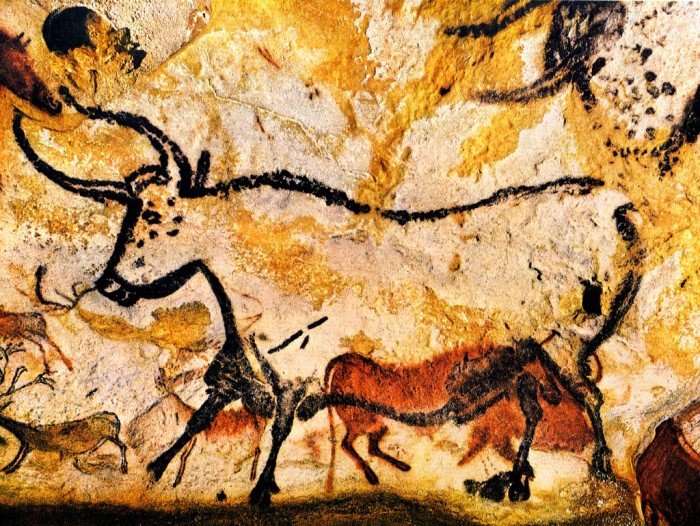
Is the person who painted these aurochs on the wall of the Lascaux cave an artist?
Observe this image; artist or not, without a doubt, this was someone with excellent vision. A person who observed many aurochs, and paid attention to them. If you look up more modern representations of aurochs, you will see that this painting represents very well, and with a certain “naturalness”, the proportions and the bearing of these now-extinct animals. The figures in the background — blurry, undefined — allow us to imagine an expanded space, with other animals in the back, circulating… but stop, now, with these interpretations — this is not a work of art, despite its mysterious beauty.
Or do you think our cave ancestors crowded around these images to discuss aesthetic concepts? This type of image holds a ritual function, one of distancing. Yes, probably, our ancestors gathered to look at these paintings. Observing this image was important for understanding the nature in which they were immersed and which daily challenged the species’ survival. Fixing the image of an aurochs on a wall made it possible to meditate on this animal; to conceive ways of identifying it, attracting it, bringing it down.
Do you find that strange? We do it to this day, and more and more. You are going somewhere unknown — beforehand, you look at maps, you might even take a street view stroll before actually going to the place. Going to meet someone? Check their profile on some social network first. Some people will try to tell you that our behavior is being modified by the Internet, but we have done this forever! I really like this quotation from the book Typecasting, by Ewen & Ewen (the translation is mine):
We are informed about the world before we see it. We imagine most things before we experience them. And those preconceptions, unless education has made us acutely aware, govern deeply the whole process of perception. They mark out certain objects as familiar or strange, emphasizing the difference, so that the slightly familiar is seen as very familiar and the somewhat strange as sharply alien.
That is why I consider the term rupestrian art rather misleading — it may give the impression that this is art (as we understand it today), only made in another era, which is a lie. A very beautiful lie, but a lie like any other. You see an image painted on a wall: this must be art! Stop that. At some point in the text I will pick up the reasoning from this point; let us advance a little in historical time and look at another image now.
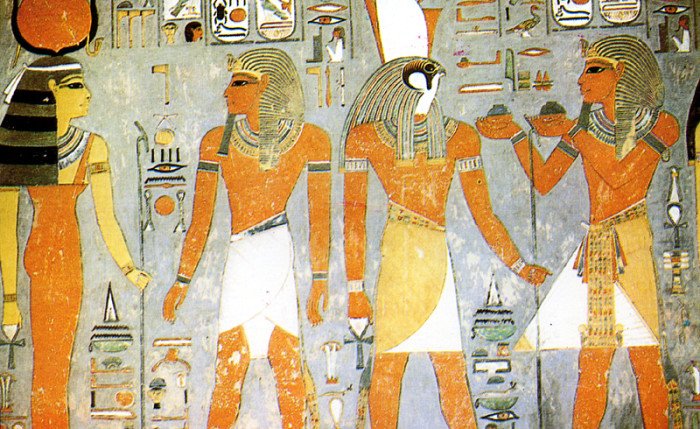
Guess what: the image above is not art — not as we understand art today. Or at least as we understand it in this text. We are considering art that which is made by artists; in Egypt, there was no artistic class. “But what about the artisans?!” — exactly: artisans. The scribes and the priests stand above them in the social pyramid, and it is they who will determine what the artisan will make. By the logic of contemporary art, by the logic of the project — how I detest that word — the scribes are closer to our contemporary artists than the artisans.
The images found in the pyramids do not ask to be read the way we have grown used to reading our works of art; they were not created to be aesthetically appreciated. The paintings in the pyramids, like those in the caves, also served as spiritual and social guides; they were a way of organizing certain conducts and social and ritual structures. Many of the symbols were used for protection and for warding off evil spirits. You, ancient Egyptian, want to know what happens after the death of your physical body? Or to understand what you may or may not desire, according to your social position? Want to remove the evil eye cast by the priest’s bastard son who wants to usurp your throne? These paintings can help you.
What I want to show is that the creation of images, in its origins, was used by the human being as a guide and reference for a mysterious world. A day passes very quickly; the clouds change all the time, the Sun rises and then sets, animals come and go, plants have their life cycle: how to understand all this? How to organize the elements so as to make life less unpredictable? After all, I want to have something to eat every day and, if possible, to wake up with all my limbs intact. And if I can lead a life that does not take me to a post-mortem hell, why not?
Images were used, even if unconsciously, mainly to this end: a way of obtaining distance from the facts, to understand nature, to tame destiny, to create something knowable etc. In this way, the makers of images performed an extremely important social function and, in a certain way, held a kind of power in their hands — a power against which Plato would later rise up. Plato understood how susceptible we are to images, and warned: images could lead the human person into a world of illusions, and the makers of images could use them to manipulate reality. Sounds very contemporary? Hold that thought for a moment; we will return to it. Let us jump in time once more; this time straight to the 17th century:
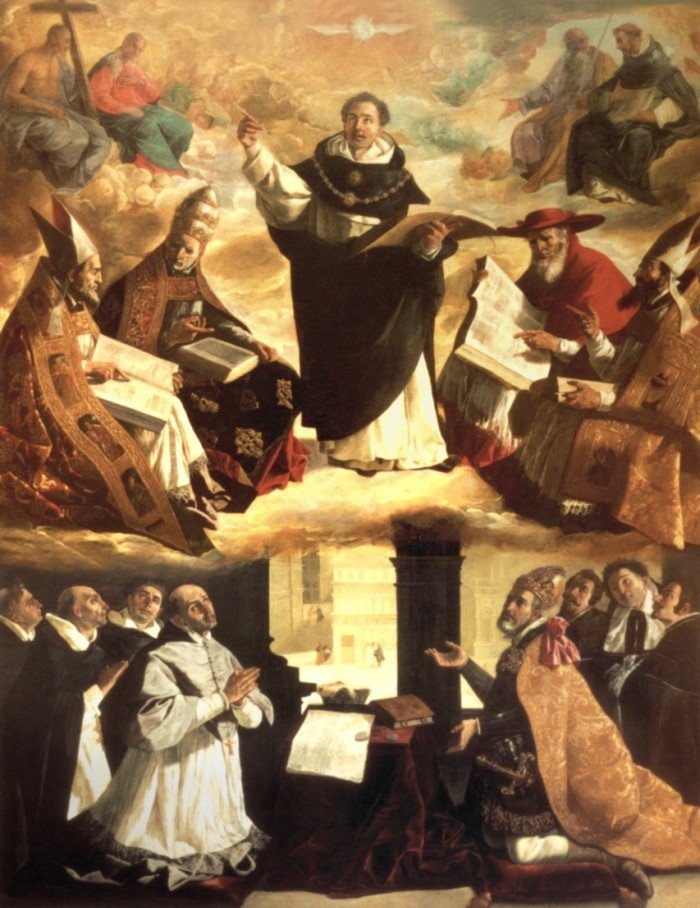
What can this image have to do with the previous ones? “The bishops’ hats look like the pharaohs’“… Please, stop that. Do not start looking for similarities in the images; the secret lies in why they were created.
In the 17th century, science was taking a few steps — nothing very important, trifles like electrical energy and the law of universal gravitation, the telescope and the microscope… A worldview of obscurantism, offered as reality for centuries by the Catholic Church, was being challenged. In the 17th century Galileo was burned at the stake, no less [historical slip kept from the original: Galileo was sentenced to house arrest; Giordano Bruno was burned]. The Inquisition knew how to sort things out when the danger was too great — fire leaves little room for doubts and questionings, especially when you are tied to a stake being consumed by flames. But the Church had other methods for discouraging people from asking undesirable questions, and painting was one of them.
Observe the image. The more I observe it, the more I like it. On the physical plane, religious men pray, argue, are tormented by worldly questions, look to the sky for help. Normal — the religious do this to this day. The curious thing is that on the celestial plane, they are there too, discussing the scriptures, with their enormous, heavy books. The celestial plane itself is in want of discussions, clarifications, light: such is the destructive power of science that even in the divine hosts the scriptures need to be seen and revised. But we can rest easy, for religion is itself conceived and brought down from the celestial plane — the bishops are up in heaven debating, right? And, on a divine plane above the celestial one, a curious image: the saints sit there, almost oblivious to what goes on below them, not looking down (the divine is immutable).
The first point in common among the 3 images is distancing — an event is frozen so we can contemplate it more attentively (note that the most “realistic” event of the 3 is precisely the cave painting).
The second point is the ritual function of images — a bridge of access to a reality beyond human comprehension. Aurochs are unpredictable and wild; in the Egyptian world of spirits there are codes and symbols important for guiding neophytes on their journey; the Catholics’ paradise is under threat and cries out for faith, devotion…
Now, the third and most important point — most important for what I want to argue in this text — is the following aspect: the three images are anonymous. Did you notice? In none of the three images do we know who the person who created them was. “They must have forgotten to sign.” My god, don’t even start.
Ugh-of-the-severed-ear may well have painted that aurochs, Thutmose Radagacuca may today be flying through the astral plane, proud of his millennia-old hieroglyphs, and the painter of the Christian scene may well be some anonymous Giovanni who died poor (I chose three men on purpose; women artists are a very recent conquest, congratulations to us). But the fact is that speculating about the authorship of these images makes no sense at all.
Why? Because what matters in these images are the realities they deal with — mystical realities, beyond human reach. From wild animals to bearded divinities, the most important thing in these images is the images themselves — the author is the least important. Signing a religious painting could be considered heresy — the painter placing himself in a position of greater importance than the very saints he is portraying. “But I spent years enduring hunger and poverty in my atelier to be able to paint these saints!” — cried the wronged artist. “But your talent and your effort are gifts from God. Now be quiet while I go fetch the matches,” said the inquisitor.
Both the Egyptians’ images and those of the old Catholics follow a specific modus operandi — called, in art, canons. There is a right way to paint these figures, a symbolic code to be followed to the letter. What does it matter who created the images? They will all look very much alike anyway. There was not much room for an individual genius. The attentive reader may object: you used a 17th-century painting. In the seventeenth century there were already artists who painted pictures of mythological-pagan content and signed their works. Of course there were — but those were considered heretics and were persecuted. Which brings us to the first crucial question of this text:
When and why did the makers of images leave anonymity and begin signing their works?
The answer lies in something like “the democratization of media”. That sounds very twenty-first-century, but I will show you that these waters have flowed before. I will take an example from literature, but it will serve. Imagine a world where images, texts and other kinds of intellectual creation mostly came into public view anonymously, without our knowing those responsible for their creation. On one hand, we could appreciate these works in a more “detached” way, without tying things to one specific person. On the other hand… I will hand the floor to Arthur Schopenhauer, speaking about the literary criticism of his era (eighteenth century):
All anonymous reviews are suspect of deceit and falsity. Therefore, just as the police do not allow people to walk the streets masked, it should not be permitted that they write anonymously. (…) But, in literature, as long as such a prohibition does not exist, all worthy writers should unite to proscribe anonymity with the stigma of a public contempt, tireless and daily expressed, demonstrating in every way the notion that writing criticism anonymously is an indignity and a dishonor. (…) Therefore, every time reference is made to an anonymous critic, even in passing and without reproach, epithets should be employed such as: “The cowardly anonymous scoundrel says” or “The disguised anonymous knave says in that newspaper”, among others. This is, indeed, the reasonable and appropriate tone for speaking of such fellows, so that the trade they ply may be execrated.
First, appreciate what a pearl of good writing that is. I took it from a booklet called The Art of Writing; all of humanity should read it. Second, this text gives us a fine portrait of the problems of anonymity: from the moment discourse is no longer homogeneous, someone needs to be held responsible. Michel Foucault wrote a book called What is an author? — I drew on that book for the title of this essay. Let me quote a passage in synergy with the Schopenhauer excerpt:
But “literary” discourses can no longer be received unless endowed with the author function: any text of poetry or fiction will be asked where it came from, who wrote it, on what date, in what circumstances or from what project. The meaning we confer on it, the status or value we recognize in it, depend on the way we answer these questions. And if, following an accident or the explicit will of an author, a text reaches us anonymous, the game of finding the author immediately begins. Literary anonymity is not bearable to us: we accept it only as an enigma.
In his book, Foucault defends the thesis that authors began to emerge to the extent that literary discourse became punishable. It makes sense — Schopenhauer was truly committed to bringing anonymous writers into the light and making them responsible for what they wrote. But what does this have to do with the democratization of media? We could never be talking about eighteenth-century literature without considering this factor. Let me present one more dusty portrait to you:
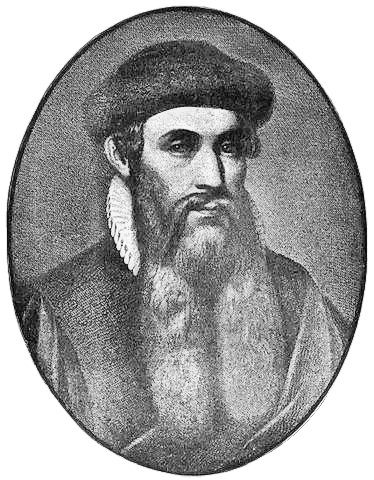
I refuse to talk at length about Gutenberg, since we all learned about him in school (even if in generic sentences disconnected from reality), but, in a quick 1-2-3, I will try to summarize the events related to his historical role:
- Until the year 1439, book production was practically 100% controlled by the Church; monks wrote books by hand and these were kept in libraries and were extremely valuable; try to imagine a “scientific community” under those conditions;
- Gutenberg invents the movable-type press, a mechanism that made it possible to print the same text many times;
- Books begin to be produced not only by the Church; independent publishers begin to appear; the Bible is translated from Latin into German; mastery of the scriptures is no longer exclusive to the Catholic church; etc.
Here is an alternative to the canonical mode of creation — creating under a certain predetermined set of values. Not coincidentally, books begin popping up everywhere, many of them written without religion’s seal of approval; science would begin to flourish at a rhythm never before experienced from this point on. Democratization of media. Yes, a book is also a medium. You can only be a Steve Jobs fan if you don’t know basic history.
This happened on the Internet too: people became more responsible over time, in the sense of being traceable to a person in the physical world, and punishable for their acts. In the old days, in the ’90s, I accessed the Internet from behind a handle like #~!!>d3d05<??~#. All of it in some obscure chat room. Today, you type my first and last name, see my photos, know where I live etc.
When I was a 12-year-old preteen, a kid at school who hated me (it was mutual), but who was bigger and stronger than me, came up one day to threaten me: he was going to beat me up after class. At that age I already had a website (and suffered what is today called bullying for being a kind of nerd), and I told that idiot that if he hit me, I would publish on the Internet everything I knew about him that was worthy of shame, including the girl he was in love with — all of it anonymously. At the time, publishing on the Internet was not so simple — I knew how, and he didn’t. Result: he gave up on beating me. Today, I would take a punch in the face. That is dilution of power; that is democratization of media.
You may have noticed we have reached the end of the text and still have not discussed what an artist is. Of course we will get there — maybe in the next text, maybe I will have to write two more. But it is important to tread carefully on this subject. Today I presented some factors that led to the consolidation of the artist’s identity. In the old days, the closest thing to today’s artist was an anonymous artisan in the service of a greater force. We are almost at the part where the shit is spread by the enormous fan of technology.
You may argue that I am making cutouts of history to compose an argument, and I will not contradict you: you are right. All authors do this. I cannot give you guarantees that we will arrive at some kind of truth at the end of all this, but I can assure you of two things:
- I was not paid to write this, unfortunately;
- I do not want to sell you anything. Neither my site nor my blog are vehicles of advertising — search all you want.
Next chapter: What is an artist? Part 2: the pencil of nature (not yet republished; it survives in the Internet Archive).