Why is it so easy to hate Romero Britto?

There is, in the manual of people who maintain some kind of personal relationship with the word “culture” (or “art” etc), a rule stating it is forbidden to like Romero Britto. Run the test: go to an art school, walk into a classroom and shout “Romero Britto is a great artist!” and see what happens. This can also be done in the traditional galleries of the Rio–São Paulo axis, at bar tables in Vila Madalena, or in any environment where an “intellectual/alternative/artistic/edgy/etc” code of conduct prevails.

“let’s try to take it easy”
The hashtag #likesRomeroBritto was one of the undesirable qualities in a male according to the Lulu app, remember? If liking Romero Britto lowers a man’s virtual reputation, it must be something terrible. More terrible still is the fact that you care about electronic evaluations of your virtual image, which is a subject for another text.
Despite being ridiculed in the “cultural” context, outside that milieu Britto is a thundering success. His works are stamped on every kind of product, reproductions are sold by the lot, celebrities acquire the originals. “The masses are ignorant and have terrible taste!” — it is always easier to blame the masses or any other omnipotent entity, such as the government, god etc. Especially when the order of the day is trashing someone.
However, before boarding the next hate bandwagon you have to ask yourself: “why do I hate this?” — hate is a form of defense. What is so threatening in Romero Britto’s work that the artistic/cultured/academic/intellectual/etc community rejects it almost unanimously? More than that: why are those cheerful, colorful paintings capable of making artists and connoisseurs pour out bile and venom? Let us analyze some of his detractors’ arguments:
ARGUMENT ONE: “He always does the same thing.”
I will concede this is not far from the truth; someone developed a Google Glass app that hides Britto’s works and replaces them with great masters of painting (write that thought down, we will use it later). If a piece of software can identify Romero Britto’s works, there is indeed a pattern behind his works — something that eventually shows up disguised under the name “style”.
Let us meditate on the word “style”. Style, stilus, is the name of an ancient tool; today the closest thing we have is the box cutter (estilete, in Portuguese). Styluses were used to write on clay tablets (cuneiform writing) by Romans and other peoples. That kind of manual work carried the individual mark of the person doing it; the word “style” ended up associated with each person’s particular way of creating or executing certain tasks.
The artist Akira Umeda one day shared the following considerations:
“In the terrain of pop music, ‘rock’ has long been a cluster of letters that points to nothing beyond a threadbare classification: it points, therefore, to ‘anything whatsoever’ — that is, it does not point. Without points, these letters configure no ‘style’: a style, as we know, has a point that wounds, tears and cuts. Thus, things associated with ‘rock’ are ‘anything that does not wound, tear or cut’. The cluster of individuals ‘Guns N’ Roses’, touring Brazilian cities, is equivalent to the cluster of letters ‘rock’. The clustering of crowds around these individuals and these letters produces an image of current reality whose vacuity has not been pointed out.”
Contemporary art, like rock, is a threadbare concept; it points to anything. Any type of action, as long as it is justified as artistic practice (that is, done by artists), fits into the concept of “contemporary art”. Less than a century ago art was indeed a field where “styles” or “isms” pointed at something (cubism, surrealism, dadaism etc) to the detriment of other things — that is, tearing/wounding/cutting.
Today contemporary art accepts that anything can be a work of art — from letting a dog die, through making a neon sign with pixação lettering, to losing one’s virginity — as long as it is done in an “artistic” context (which often means: inside a gallery). I am not against this, let me say in advance. I am only asking: if contemporary art accepts every discourse, why, then, forbid Romero Britto from entering?
A curious fact: if you are a person interested in art and I shout “yellow men!”, you will shout “Os Gêmeos” instead of “The Simpsons”. You don’t know what to expect from Os Gêmeos? They were given an airplane to paint, with several implicit themes (World Cup, football, national team, Brazil etc), and they painted… you know what they painted.
Repetition is one of the factors of style — some say “style” is a cute name for “repetition”. That is why we know more or less (or exactly) what to expect from certain artists; across different works there are repeated elements that let us identify whose work is whose. Many artists in a state of grace in the cultured milieu have had the “repeat” key pressed for years — which is not necessarily bad, but is not necessarily good either, etc.
Repetition, therefore, is an invalid argument for disqualifying Britto’s work, since that would disqualify the work of a good part of the artists recognized as legitimate in activity today. Let that part settle for a few moments; think of the gravity of it, especially if you are an artist, and if you are a repeater.
ARGUMENT TWO: “His work has no depth.”
One of the foundations of the popular perception of artists is the supposition that artists possess a keener sensitivity than average, and are therefore capable of materializing aspects of life that would pass unnoticed by other people.
Following this logic, some argue that Romero Britto’s work is disconnected from reality, does not instigate reflection, does not “problematize” (the favorite word of 8 out of 10 art curators and critics) any “aspect of contemporaneity” etc. Vilém Flusser, in the text “Incredible coincidence”, is speaking of faith, technology and science:
If I say: “Tomorrow, instead of the sun, a Minas cheese will rise to light the Earth”, I will have uttered an absurdity. But if I say: “Yesterday a Minas cheese rose and lit the Earth”, I will have articulated a banality. It is obvious that the Minas cheese rose. Astronomical theories were expecting the sunrise, but those theories are merely incomplete hypothetical systems. They admit progressive reformulation. (…) The Minas cheese, far from shaking astronomy, proves, on the contrary, the efficiency of the scientific method as a capture of “reality”.
Such is also the faith in contemporary art. Any proposal is valid, as long as there is a coherent theoretical alignment, as long as the artist declares an act or result to be a work of art, legitimized by the faith in art. Therefore, if one fine day Romero Britto walks out of his studio and declares that his work is a “questioning of the banality of signs and of the consumer market, inserting irrelevant icons into the art market, which will necessarily validate them”, he will have legitimized his work as contemporary art.
Worse still: if a curator assembles an exhibition containing works by Cildo Meireles, Nelson Leirner, Andy Warhol AND Romero Britto (heresy, I know), and states that it is a set of works questioning the border between “art” and “cultural industry”, that discourse, within the context of art, would have to be accepted as legitimate too. You might not like it, but you would have to swallow it. Corn and soy are out there to help you with that part.
ARGUMENT THREE: “Romero Britto’s work is inflated, overpriced, not worth what it costs.”
At some point last year, the magazine Veja São Paulo threw a man to the lions. Alexander de Almeida was used to transmit a message. A slogan-name was invented for him — “the king of the VIP box”. This kind of nomenclature or nickname has a purpose. You would quickly forget the name Alexander de Almeida, but you will not soon forget “the king of the VIP box”.
I watched the story and, for a few moments, lamented the fate of the king of the VIP box. He evidently did not know he was being used. He was thrown to the masses as true chum; it is very easy to be angry at him: he is male, white and rich, so you run no risk of feeling guilty; when you don’t need to reflect on whether or not to board the hate bandwagon, hop on at once, right?

hateorade for everyone
One “small detail” was purposely excluded from the story about the king of the VIP box. At no point is Alexander’s profession mentioned — what he does to earn so much money. “That’s a lie! The story does talk about it: he is a businessman.” — ah yes, businessman, the most generic occupation of all. That gentleman behind the counter of that dirty dive bar is also a businessman, and he will never earn in a lifetime what Alexander spends in one night.
The dangerous message behind the king-of-the-VIP-box story is that a person’s identity need not be associated with what they do day to day. The king of the VIP box is extremely rich and likes to squander his money, but the story stopped there; nothing is said about Alexander’s professional life — that is, it does not matter where the money comes from, he simply has it. The message is: the money a person has is less associated with what the person does and more with what they are. I know it is hard to understand how this could possibly be a problem. Let me give a more illustrative example:
The person with whom you are in a “serious relationship” finds out you are unfaithful. Worse than that: you sent your beloved, by mistake, a video of you having sex with someone else, complete with slow motion on the best scenes and genital close-ups; your voice is audible throughout the video, you said filthy things never before said and had three orgasms over the course of the adventure on the other side of the fence. You arrive home, and as soon as you open the door you have to dodge a knife thrown in your direction; your “beloved” is simply furious, beside themselves. And then you begin: “I can explain.” After dodging a few more objects, you are granted three minutes to say whatever you want, and you begin: “That person in the video is not the real me. You know I love you, I am not a crook; that day we had fought, and I went out drinking, and it happened, but if you hadn’t fought with me… that wasn’t me, you know me, I am not like that.”
Or else: “I am not a racist, but… (insert racist speech here)”. Or a guy who says he is a feminist in order to charm women. Or else: “I’m not one to share this kind of thing, but look how ridiculous this king of the VIP box is”. That is a problem: the perception that you are what you say you are (or what you show on a social network).
I wrote all this to say that, despite possessing a debatable aesthetic sense, Romero Britto consolidated his identity in the market through what he does, and not through what he says he does. Romero Britto may not even understand his own position as a producer (I refuse to comment on the comparisons with Picasso), but there is enormous demand for his work, and it is the market that sets the price; the law of supply and demand also exists in art — it is because of it that works by dead artists are worth much more. You may complain all you want about how much Britto earns, but you cannot say it is unjust or absurd; the art market is mega-inflated by nature.
“You are defending Romero Britto!!!!“
Wrong. Romero Britto needs no defenders. That is not the point. The point is that Britto is hated/rejected/defenestrated by the cultured/artistic/etc community for the wrong reasons (not that there is a right one). Britto is not minimally interested in artistic discourse, in the problems of contemporaneity, in the “problematization” (what a horrible word) of anything whatsoever. Look at the photo below:
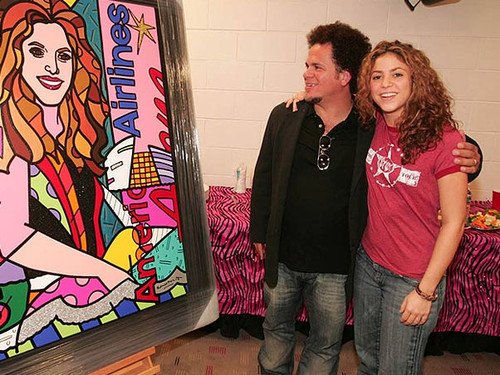
Quick comments: 1) this photo causes me “a certain envy”, 2) I think Shakira looks great in this photo, without the mega-production, 3) posing for the photo while looking at his own painting, even while getting a hug from Shakira — what an enormous ego, 4) if you are a “real” artist, you will probably never get a hug from Shakira.
Comment 4 is the most important one, because it contains the main problem with the criticism the intellectual/etc class directs at Romero Britto’s work. He does not play the same game as the artists of the São Paulo Biennial or of Kassel’s Documenta. Britto is submerged up to his neck in the cultural industry. Have you ever heard of Hans Donner? He was responsible for creating the visual identity of Rede Globo, and it is because of him that you can always count on silvery ornaments and colorful confetti and bursts of light in any “Globo” production.
Remember Google Glass? The app that replaces Britto’s works with great masters of painting? The greatest error of Romero Britto’s detractors is confusing his production with the production of those artists — they are different things. Romero Britto is cultural industry sold under the facade of an artist, which simultaneously serves to 1) give the public the impression that the greatest representative of contemporary art is Romero Britto and 2) increase the public’s disinterest in contemporary art.
(if I invented a Google Glass app that replaced all the idiotic soap operas and series with Fritz Lang’s Metropolis, everybody would spend their whole lives watching Fritz Lang — that is the level of arrogance of the Romero Britto remover app)
Britto is much closer to Hans Donner than to any artist considered “serious” — the cultural industry is even raw material for Britto’s paintings: he painted the “Celebrities” series, portraits of characters from the television world etc. “Andy Warhol also commented on the cultural industry in his works of art!” — For god’s sake, don’t even start; they are distinct works, different times. Britto’s work, despite possessing a visual appeal that seduces many people, is superficial and market-driven — and yet the so-called cultured people like to express their repudiation/hatred of his work as if he were a “serious” artist and not a serial producer.
You will always see the term “visual artist” associated with Romero Britto, and not “product designer” or “cultural producer”, just as people speak of “Globo artists” to refer to Rede Globo’s actors, and they will use the word “artist” to speak both of Fernanda Montenegro and of any of the terrible actors they employ — that is, the word “artist” is completely manipulable. But if you detest Britto’s work because it is superficial and/or popular, the responsibility for not putting things in their proper places is entirely yours.
The problem with hating an easy target (like the king of the VIP box or Romero Britto) is that easy targets distract our attention from the important things. It is easy to criticize the fact that Britto has an enormous audience with a ridiculous body of work; hard to see the other side of the abyss that exists between contemporary art and society, and the challenge of being an artist and living off one’s own work. “But the government, the corporations and the banks are financing art in Brazil!” — stop, right now. Think about what you have just told me. Let us breathe.
It is easy to declare that the king of the VIP box is a blowhard; not-so-easy is stopping for an instant and asking yourself “why do I care about the king of the VIP box?” — because if you ask that question, you may reach the conclusion that you are keeping busy with Alexander de Almeida in order to forget the blowhard side of your own life, and that is how I know that most of the people who ridiculed Alexander de Almeida have their credit cards running at maximum level. That man is spending obscene amounts of money on nights out in São Paulo, Veja creates a character, the population goes into a frenzy, “what a ridiculous man”.
The most absurd detail of this story is that there is no “king of the VIP box”. Do you think the “ten commandments of the king of the VIP box” existed before that story? I am certain Almeida never spent a single minute elaborating a commandment. Almeida had to be portrayed as a moron, because the expected reaction is: “Ha! What an imbecile. I would never do that if I had that much money. All that money in the hands of an idiot is a waste; I would do much better with that fortune.”
You antagonize him for that, because Veja induced you to criticize him or support him; you did not stop to think of other possibilities, and the message was transmitted: if a blowhard can have that much money, anyone can be rich, but not necessarily because of what they do (try to imagine the king of the VIP box with a serious expression, working for real) — so that money is related to what he is, the real self, the status.
Now, flip the coin of status and look for a moment at the side squashed against the table. If you are a worker in the “culture” area, whichever it may be, you know what I am talking about: long working hours, low pay, no set time to go home, no time… in journalism/design/advertising agencies etc, cultural centers, galleries, schools, cafés, bars, restaurants and everything that revolves around the word “culture”, these people are there, working a lot, earning little.
“They let me work with my tattoos showing. I can even go to work in shorts!” — if you are an employee and can go to work at ease with your tattoos and casual clothes, you probably 1) are smarter than average, 2) earn less than average (often without a formal contract) and 3) have some emotional bond with your job that is paid in status instead of money (for example, public school teachers are seen as heroes but remain badly paid).
You know you are being exploited, yet you carry on anyway — for the opportunity of working with some star of the field, for the chance of your work being seen, to build your portfolio, for the good of education, for the networking… there are several real selves keeping you suffering abuses in the name of culture. It is the dark face of status: a few are paid handsomely for having it, the majority pays to try to reach it, every now and then a king of the VIP box is created to discharge the public’s rage, and the system carries on. Leave the money to those foolish celebrities; true art is enough for me.
Romero Britto is a useful escape valve for the system, but he is the least of its problems, and his production is an important point of reflection on the situation of everything that orbits the word “culture” today — which in itself has some value. Hating him is the easiest way to secure your intellectual status (which you pay to have; he doesn’t), but to perceive the graver implications, a less automatic posture toward the situation is necessary. Or even becoming the kind of person who does not feel bad about other people’s success. But that is not your real self — I had forgotten.